Why Are We Taxed Again for Social Security
Since 1984, Social Security beneficiaries with total income exceeding certain thresholds have been required to pay federal income revenue enhancement on some of their do good income. Because those income thresholds accept remained unchanged while wages have increased, the proportion of beneficiaries who must pay income tax on their benefits has risen over time. A Social Security Administration microsimulation model projects that an annual boilerplate of about 56 percent of beneficiary families will owe federal income tax on function of their benefit income from 2015 through 2050. The median percentage of do good income owed as income taxation by beneficiary families will ascension from ane per centum to 5 percent over that menses. If Congress does not conform income taxation brackets upward to judge the historical ratio of taxes to national income, the proportion of benefit income owed as income tax will exceed these projections.
Patrick Purcell is with the Role of Retirement Policy, Office of Retirement and Disability Policy, Social Security Administration. Questions about the analysis should exist directed to the author at (202) 358-6348.
The findings and conclusions presented in this newspaper are those of the authors and do not necessarily represent the views of the Social Security Assistants.
Summary and Introduction
| AGI | adapted gross income |
| AWI | average wage alphabetize |
| CBO | Congressional Upkeep Office |
| IRS | Internal Revenue Service |
| MINT | Modeling Income in the Near Term |
| OBRA 93 | Omnibus Upkeep Reconciliation Deed of 1993 |
| SIPP | Survey of Income and Program Participation |
| SSA | Social Security Administration |
Since 1984, Social Security beneficiaries with total income exceeding certain thresholds have been required to claim part of their Social Security benefits as taxable income. The income thresholds for taxation of benefits have remained unchanged since Congress first established them merely, because wages have increased, the proportion of Social Security beneficiaries who must pay federal income tax on their benefits has risen over time. In 1984, less than 10 percent of beneficiaries paid federal income tax on their benefits. A Social Security Administration (SSA) microsimulation model, Modeling Income in the Nearly Term (MINT), projects that 52 percent of families receiving Social Security benefits will pay income tax on their benefits in 2015. Most of these families will be in the upper half of the total-income distribution.
This effect paper presents MINT projections of the percentage of Social Security beneficiary families that will owe federal income tax on their benefits every bit well every bit the proportion of benefit income they will owe as income taxation in selected years from 2015 to 2050, with comparative information for 2010. Although 13 states likewise revenue enhancement Social Security income, the scope of this paper is restricted to federal income taxes.
In summary, MINT projects that an annual average of about 56 percent of beneficiary families will owe income tax on their benefits over the menstruum 2015–2050. For 2015, MINT projects that beneficiary families will owe a median of less than i per centum of benefits in income tax, but that one-4th of those families will owe 11 pct or more of their benefits in income tax. The model projects that the median percentage of benefits owed as income tax by casher families volition ascension to about 5 percent over the projection menses. Amidst the 52 percentage of families that are projected to owe federal income taxation on their Social Security benefits in 2015, the median share of benefits owed as taxation will be 11 percent. For those families, that proportion volition remain close to 12 percent over the period 2020–2050.
Projecting taxation over a period of decades requires sure assumptions nearly futurity tax policy. For instance, nether current law, income tax brackets are indexed to the rate of growth of consumer prices. In the long run, incomes tend to rise faster than prices every bit labor productivity increases. If taxation brackets keep to be indexed to prices, the share of benefit income paid equally taxes eventually volition rise above its historical boilerplate. Long-term tax estimates must assume either that income tax brackets volition continue to be cost-indexed or that Congress will act to adjust the brackets upwards.one The estimates in this paper incorporate the key supposition that Congress volition human action earlier 2025 to adjust the tax-bracket thresholds upward. MINT assumes that the provisions of the taxation code that currently stipulate the use of cost indexing volition change to require wage indexing after 2023. If tax brackets continue to be indexed to prices indefinitely, the proportion of Social Security benefit income that beneficiaries owe every bit income tax will be higher than the estimates shown in this paper for years later 2023.
Another important caveat nearly the estimates in this paper is that they apply merely to Social Security beneficiaries who are modeled in MINT. Adjusted by sample weights, the beneficiary population modeled by the current version of MINT represents 54.iii million persons in 2015, or 92 percent of the average monthly beneficiary population of 59.0 meg for January–June 2015 (SSA 2015b). Equally a result, MINT simulations differ from authoritative estimates produced by other federal agencies. As explained in Box 1, the difference is attributable mainly to certain income characteristics that typify the beneficiaries not simulated in MINT more strongly than they represent beneficiaries overall. Additionally, MINT simulations reverberate scheduled benefits under electric current law. However, because Social Security'due south Board of Trustees (2015) estimates that the trust funds will exist depleted in 2034—after which, Social Security payroll revenue enhancement revenue would be sufficient to pay merely nearly 75 percent of scheduled benefits—Congress volition presumably take remedial action before then. Thus, the long-term continuation of scheduled benefits under current law is uncertain, as is the timing of whatever substantial changes.
Box ane.
How MINT simulations differ from other federal estimates of Social Security benefit taxation
Each twelvemonth, the Treasury Department's Office of Revenue enhancement Analysis (OTA) estimates the corporeality of revenue generated by the taxation of Social Security benefits. The Treasury uses those estimates to credit income tax revenue to the Social Security trust funds. For 2015, OTA estimates that federal income taxes on Social Security benefits will equal nearly 5.9 percent of amass do good income, in contrast with the vii.2 per centum effigy estimated by MINT. The divergence between the two estimates stems in large part from the difference between the actual number of Social Security beneficiaries and the number of beneficiaries simulated in MINT. For case, for January–June 2015, the monthly number of Social Security beneficiaries averaged 59.0 1000000. MINT simulates a 2015 casher population of 54.iii one thousand thousand, or 92 pct of the actual number of beneficiaries. MINT excludes beneficiaries built-in earlier 1926, child beneficiaries, disabled beneficiaries younger than historic period 31, and beneficiaries who reside in nursing homes.
According to data from the Census Bureau's March 2014 Current Population Survey, the beneficiaries excluded from MINT are mostly less likely to owe income tax on their benefits than are those included in the model simulations. In 2013, for instance, 52 percent of child beneficiaries and 45 percent of beneficiaries anile eighty or older lived in families with incomes lower than 200 percent of the federal poverty threshold, compared with merely 30 per centum of beneficiaries aged60–79 (who comprise nearly two-thirds of the beneficiary population). On average, nursing home residents are older and poorer than other aged beneficiaries are; therefore, they too are less probable to owe taxes on their Social Security benefits.
If MINT simulated all beneficiaries, its estimates of taxes owed as a percentage of benefit income would be lower and, thereby, closer to the OTA estimates. As they are, MINT estimates closely resemble those of the Congressional Budget Office (CBO). CBO estimates that 51.5 million beneficiaries paid 6.seven percent of their Social Security benefits as income revenue enhancement in 2014 and projects that income taxes owed on Social Security benefits volition rise to more than 9 percent by 2039 (Shakin and Seibert 2015). MINT estimates that 52.four 1000000 beneficiaries paid 6.7 percent of their benefits as income tax in 2014 and projects that income revenue enhancement owed will exceed x percent of benefit income by 2040. Similar all estimates, these projections are uncertain and their accurateness depends on the reliability of their underlying data, methods, and assumptions.
Background
The get-go Social Security benefits were paid in 1940. From that fourth dimension until 1984, benefits were exempt from federal income tax, as authorized by Treasury Department rulings issued in 1938 and 1941 (SSA n.d.). Considering other forms of retirement income (such as individual- and public-sector pensions) were subject to income tax, policymakers somewhen reconsidered the tax exemption for Social Security benefits. Both the 1979 Advisory Council on Social Security (1979) and the National Commission on Social Security Reform (1983) recommended that some Social Security benefits exist included in taxable income.
The Social Security Act Amendments of 1983 (Public Law98-21) established that beneficiaries whose total annual income exceeds certain thresholds are required to pay income tax on upwards to l pct of their Social Security do good income. Ten years after, the Omnibus Budget Reconciliation Act of 1993 (OBRA 93, Public Police force103-66) established an additional college threshold, above which upwards to 85 percent of Social Security benefits are taxable. The 1983 amendments require beneficiaries to pay income tax on their benefits if their modified adjusted gross income (AGI)—which includes i-half of Social Security benefit income—is greater than $25,000 for single beneficiaries and $32,000 for married couples (Table 1).2,3 Specifically, beneficiaries who file taxes singly must count as taxable income the lesser of half of the amount by which modified AGI exceeds $25,000 or 1-half of their benefit income. Married beneficiaries filing joint income tax returns are required to count every bit taxable income the lesser of half of the amount by which modified AGI exceeds $32,000 or one-half of their benefit income.4 Prior to OBRA 93, all of the revenue raised from taxing Social Security benefits was credited to the One-time-Age, Survivors, and Disability Insurance Trust Funds.
| Line | Modified AGI (nominal $) | Taxable portion of income |
|---|---|---|
| Single | ||
| 1 | Less than 25,000 | None |
| 2 | 25,000–34,000 | Lesser of—
|
| 3 | More than 34,000 | Lesser of—
|
| Married, filing jointly | ||
| 4 | Less than 32,000 | None |
| 5 | 32,000–44,000 | Lesser of—
|
| 6 | More 44,000 | Bottom of—
|
| SOURCE: IRS (2015b). | ||
| NOTE: Modified AGI is AGI plus nontaxable involvement income plus income from strange sources plus one-half of Social Security benefits. | ||
OBRA 93 established the second income thresholds of $34,000 of modified AGI for beneficiaries filing income revenue enhancement singly and $44,000 of modified AGI for married beneficiaries filing jointly. Although benefit income for tax filers with modified AGI below those thresholds remains taxable according to the terms of the 1983 amendments, up to 85 percentage of Social Security benefits are taxable for beneficiaries with modified AGI exceeding the new thresholds.v The additional acquirement generated by increasing the maximum taxable proportion of benefits to a higher place the second threshold from 50 per centum to 85 percent is credited to the Medicare Hospital Insurance Trust Fund.
The income tax treatment of Social Security benefits shown in Table 1 summarizes data available in a electric current Internal Revenue Service (IRS) taxpayer guide. The income thresholds and taxable proportions set forth in the 1983 amendments and modified under OBRA 93 remain in effect today. Because the taxable-income thresholds are not indexed to changes in prices or wages in the national economy, the taxable proportion of aggregate benefit income has risen over time.
A worker'due south payroll tax contributions to Social Security in a given year are included in his or her taxable income for that year. In other words, workers pay income tax on the payroll tax. The 1983 amendments adopted the principle that beneficiaries should not pay income tax on the portion of do good income that equals their previously taxed contributions. The principle of excluding from taxation an employee'southward previously taxed contributions besides applies to pensions and annuities.half dozen
The 1983 amendments limited the taxable proportion of benefits to fifty percent because employees pay half of the payroll tax, and their payroll tax contributions were already included in taxable income for earlier years.7 Nonetheless, although the worker pays half of the payroll tax, a typical worker's lifetime payroll taxation contributions amount to much less than one-half of his or her lifetime Social Security benefits. In 1993, SSA'southward Office of the Master Actuary estimated that the payroll taxation contributions of current and future workers would equal less than fifteen per centum of the present value of their lifetime benefits (Goss 1993). Therefore, if the ratio of lifetime contributions to benefits is less than 15 pct, then upwards to 85 percent of benefit income can be taxed without risk of double revenue enhancement. On that basis, OBRA 93 increased the maximum taxable portion of Social Security benefits from 50 percent to 85 pct for beneficiaries whose modified AGI exceeds the 2nd (higher) threshold specified in that police. OBRA 93 did not modify the taxable portion of benefits between the first and second income thresholds, which continues to exist 50 percent. For beneficiaries with income below the offset threshold, all benefits continue to be tax-exempt.
In its January 1983 written report, the National Commission on Social Security Reform estimated that about 10 per centum of Social Security beneficiaries would pay income tax on their benefits if half of benefits were taxable for "persons with Adjusted Gross Income (before including therein whatsoever [Social Security] benefits) of $xx,000 if single and $25,000 if married" (emphasis added). The 1983 Amendments to the Social Security Act gear up the income thresholds for taxation of benefits at $25,000 for single persons and $32,000 for married couples (with income including 1-half of Social Security benefits). Thus, the income thresholds Congress established for tax of benefits were higher than those recommended by the Commission, but the effect of the higher thresholds was partly offset past requiring taxpayers to include one-half of their Social Security benefits in the income computations.
When the 1983 amendments went into effect, about viii pct of beneficiary families were required to pay income revenue enhancement on function of their Social Security benefits (House Ways and Ways Commission 2004). That percentage has increased over time because the 1983 amendments prepare the thresholds for taxation of benefits in nominal dollars, rather than indexing them to price or wage changes in the national economy.8 By 1993, an estimated xx percent of beneficiary families paid income tax on role of their benefits (Pattison and Harrington 1993). Subsequent estimates by the Congressional Budget Office (CBO) put the percentage of beneficiaries paying income tax on their benefits at 25 percent in 1997, 32 percent in 2000, and 39 pct in 2003. More recently, CBO estimated that 49 percent of Social Security beneficiaries paid income tax on their benefits in 2014 and that their average tax payment equaled 6.7 percent of do good income, although "less than xxx percent of all Social Security benefits paid out in 2014 were subject to income tax" (Shakin and Seibert 2015). The authors also projected that more than than 9 percent of benefits will be owed every bit income tax by 2039.
Although the percentage of families that pays income tax on Social Security benefits has risen, not all beneficiary families are required to file an income tax return, and not all beneficiaries who file a return owe income tax on their benefits. Individuals and married couples must file a tax return only if their taxable income exceeds the sum of the standard deduction and personal exemption amounts in effect for that twelvemonth.9 For case, in 2016, a single person younger than age 65 volition take to file a federal income taxation return only if his or her 2015 income from nontax-exempt sources exceeds $x,300. For married couples in which both spouses are younger than age 65, the income threshold for filing a tax return for 2015 will be $20,600. Single persons aged 65 or older will have to file a tax return in 2016 only of they accept 2015 income of more than $11,850. Married couples in which both spouses are 65 or older will have to file a tax return only if their 2015 income exceeds $23,100.
Data and Methods
The MINT microsimulation model was used to estimate the proportion of Social Security beneficiary families that will owe federal income taxation on their benefits and the percentage of do good income they volition owe as income tax over the menstruum 2010–2050. Microsimulation models utilise information about a sample of "micro units" such equally individuals, families, or households to estimate how changes in their characteristics or behavior will affect the entire population or a selected subgroup such as workers or retirees. These models are widely used by federal agencies to analyze the distributional effects of public policy proposals. In addition to SSA, agencies such as the Department of Agriculture, the Section of Health and Homo Services, CBO, the Congressional Research Service, and the Government Accountability Office have used microsimulation models in recent years to approximate the furnishings of policy proposals on beneficiaries of federal programs. Smith and Favreault (2013) observe that microlevel information, when "combined with detailed representations of programme rules, tin inform policy by revealing interactions and trends that more amass analyses may fail to capture."
MINT links demographic data from the Census Bureau'due south Survey of Income and Program Participation (SIPP) to Social Security earnings records to simulate the effects of culling policy and economic scenarios on individual and family income. The MINT income revenue enhancement computer statistically matches the records for private SIPP respondents with similar records in the IRS Statistics of Income data file. The projections in this newspaper use MINT version 7 (MINT7). MINT7 simulates federal income tax liability based on income tax parameters in consequence through 2013, including the provisions of the American Taxpayer Relief Human action of 2012 (Public Constabulary112-240).
MINTseven simulations begin with a representative sample of the noninstitutionalized U.S. adult resident population born after 1925, based on records from the 2004 and 2008 SIPP panels that take been matched to Social Security earnings records through 2010.10 Adapted by sample weights, the beneficiary population modeled by MINT7 represents 54.3 million persons in 2015. That number is equal to 92 pct of the monthly average of 59.0 million persons who received benefits from Jan through June 2015. Beneficiaries omitted from the MINT7 sample include those born before 1926, children, disabled individuals aged 30 or younger, and nursing abode residents.11
The Internal Revenue Code requires the income brackets to which each marginal tax rate applies to be indexed to almanac price inflation, as measured past the Consumer Toll Index. If tax brackets keep to be indexed to prices, taxes as a share of national income will rise substantially. Consequently, long-term estimates of income taxes must assume either that the income taxation will one solar day eat a larger pct of national income than it does today or that Congress volition act to prevent such an increase by adjusting the brackets upward.
MINT7 simulations assume that Congress will deed to keep the proportion of national income paid as income tax from rise substantially above its long-term historical boilerplate. Specifically, MINT models the current revenue enhancement policy of toll indexing through 2023 and assumes a switch to wage indexing using the national average wage index (AWI) thereafter.12 This is a critical assumption because over fourth dimension, wages—which are the largest unmarried source of income—tend to rise faster than prices as labor productivity increases. For case, the Social Security Lath of Trustees states that over the period from 1967 through 2007, wages grew faster than prices by an average of 0.nine percentage points per year. The Board as well assumes that the average rate of growth of wages will exceed the boilerplate rate of toll inflation by virtually 1.one percent points over the next 75 years (Board of Trustees 2014).
MINT simulates tax-filing units, which in well-nigh cases are either unmarried individuals or married couples filing joint tax returns.13 For simplicity, all revenue enhancement-filing units that include at least i Social Security beneficiary are called "beneficiary families," regardless of whether the unit is a unmarried person or a married couple in which i or both spouses receive Social Security benefits.
MINT Simulation Results
This section discusses the projected prevalence and relative amount of income revenue enhancement liability on Social Security do good income, based on the MINTvii simulations. The charts and tables illustrate wide trends by showing the projections in five-twelvemonth intervals (quinquennially).
Casher Families Filing a Revenue enhancement Return and Owing Income Tax on Benefits
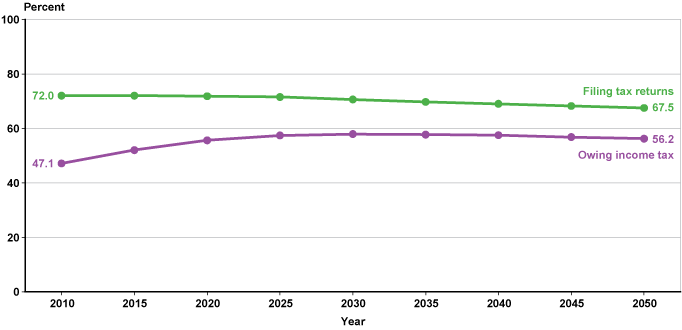
Chart 1 shows the projected percentage of Social Security beneficiary families that will file a tax return and the pct that will owe income taxation on their benefits over the catamenia 2010–2050. MINT projects that nigh 72 percent of beneficiary families will file an income tax return through 2030, after which the proportion volition fall slowly to about 68 percent past 2050. The decline after 2030 reflects assumptions of both a change from cost indexing to wage indexing for tax brackets later 2023 and a reduction in the rate of growth in retirement income from pensions and other not–Social Security sources.
Chart one.
Percentages of Social Security beneficiaries filing income revenue enhancement returns and owing income tax on their benefits, 2010 and projected quinquennially 2015–2050
SOURCE: Author'due south calculations using MINTvii.
As noted earlier, some beneficiaries who file income tax returns do not pay taxes on their benefits considering their modified AGI does not exceed the taxable threshold. MINT projects that the proportion of casher families that volition owe income tax on their benefits will increment from about 47 per centum in 2010 to 52 percent in 2015 and to 58 percent in 2030, and so volition fall slightly to about 56 percent by 2050. Hither too, the projected pass up afterward 2030 reflects the assumption of both the change from price indexing to wage indexing for taxation brackets and a slowing rate of growth in retirement income from nonbenefit sources.
Share of Benefits Paid as Income Taxation
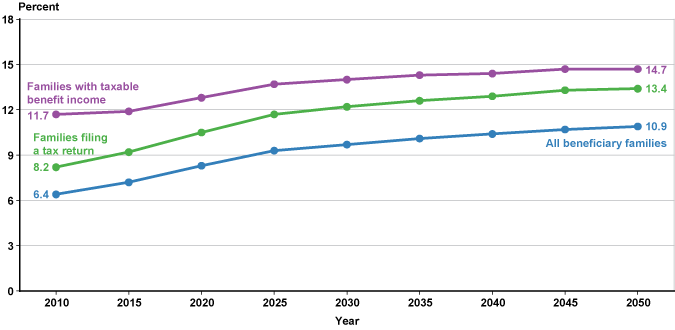
Chart two shows the projected mean percentage of Social Security benefits paid as income taxation by three casher-family groups: all such families; families that file a tax return; and families that owe any income tax on their benefits. Amidst all beneficiary families, MINT projects that the mean percentage of do good income owed every bit income tax will increment from 6.4 pct in 2010 to vii.two pct in 2015, to 9.7 percent in 2030, and to 10.9 per centum by 2050. Because the income thresholds for taxation of benefits are stock-still in nominal dollars, long-term growth in total income will event in a rising share of benefits being paid as income revenue enhancement, even if revenue enhancement code parameters currently indexed to toll inflation are instead indexed to wage growth in the future.
Nautical chart 2.
Mean percentage of Social Security do good income owed equally income taxation: Three beneficiary-family categories, 2010 and projected quinquennially 2015–2050
SOURCE: Author'south calculations using MINT7.
For casher families that must file a revenue enhancement return (regardless of whether they owe income taxes on their benefits), MINT projects the mean percent of benefits owed equally income tax to increase from 8.2 percent in 2010 to 9.two percent in 2015 and to 12.2 percent in 2030. By 2040, beneficiary families that file revenue enhancement returns volition owe an average of 12.nine percent of their benefits as income tax.
For casher families that must pay income tax on their benefits, MINT projects that the mean per centum of benefit income owed as income revenue enhancement will increase from xi.7 percent in 2010 to 11.nine percent in 2015 and to 12.two per centum in 2030. By 2050, MINT projects that families that owe whatsoever revenue enhancement on their benefits volition owe 14.7 percent of their benefits as income tax on average.
Median Pct of Benefits Owed as Income Tax
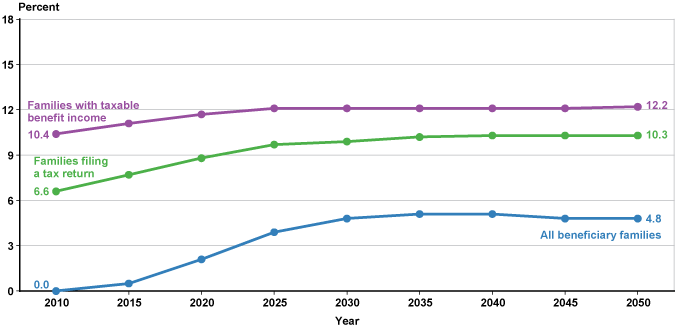
Taxes due for the typical casher family unit are perhaps best represented by the median percentage of benefits owed as income taxation. The median lies at the midpoint of the distribution, with equal numbers of families having college and lower percentages due. Chart iii shows the projected median percentage of benefits owed as income revenue enhancement amidst beneficiary families in the same 3 groups represented in Nautical chart 2.
Chart 3.
Median percent of Social Security do good income owed as income taxation: Three casher-family categories, 2010 and projected quinquennially 2015–2050
SOURCE: Author'due south calculations using MINT7.
Among all beneficiary families, the median percentage of Social Security benefits owed equally income tax was zero in 2010 and is projected to exist simply 0.5 pct in 2015. The median income tax liability on Social Security benefits amongst all beneficiary families volition rise to 4.8 percent in 2030 and will then remain relatively stable over the following 20 years.
Amongst families that file a taxation return, the median pct of benefits paid as income tax was 6.6 per centum in 2010 and volition be 7.7 percent in 2015. MINT projects that pct to rise to 9.9 per centum in 2030 and to 10.3 percent by 2050.
Among beneficiary families that owe any income tax on their benefits, the median percentage of benefits owed as income tax was 10.four percent in 2010 and will rise to 11.1 percent in 2015. MINT projects that share to reach 12.1 percent in 2025 and then to remain stable over the post-obit 25 years. The percent of benefits owed equally income tax will stabilize because most families that owe income revenue enhancement on their benefits will be in the 15 percent marginal income taxation bracket, and most of them volition be paying taxes on the maximum 85 percent of benefits.
Benefit Income Owed as Income Revenue enhancement Higher up and Beneath the Median
Some beneficiary families owe considerably more than or less than the median percent of their benefits in taxes. Every bit Nautical chart i shows, 56–58 percent of casher families volition owe some income revenue enhancement on their benefits over the next several decades. Conversely, 42–44 percent of beneficiary families will owe no income tax on their Social Security benefits in any given year, again assuming that tax brackets will be indexed to wages rather than prices subsequently 2023.
Under electric current law, the highest pct of Social Security benefits that any family pays as income taxation is 33.7 percent. That figure represents the production of the maximum proportion of do good income that is taxable (85 pct) and the highest marginal income tax rate (39.half dozen percent). In 2015, the 39.vi per centum marginal tax rate applies to taxable income to a higher place $411,200 for unmarried persons and to taxable income to a higher place $464,850 for married couples filing joint returns. MINT projects that less than 1 percent of beneficiaries will owe 33.7 percent of their benefits as income tax in 2015 or in any yr through 2050 (non shown). In 2015, an estimated 80 percentage of beneficiaries filing singly and 79 percent of married couples filing jointly are in either the 15 per centum or 25 percent marginal tax brackets (Table two).
| Marginal taxation rate (%) | Filing status | |
|---|---|---|
| Single | Married, filing jointly | |
| Total | 100.0 | 100.0 |
| ten.0 | 5.7 | 4.9 |
| fifteen.0 | 36.0 | 42.ix |
| 25.0 | 43.ix | 35.9 |
| 28.0 | 11.0 | viii.0 |
| 33.0 | 3.1 | 6.one |
| 35.0 | a | 0.7 |
| 39.half dozen | a | 1.five |
| SOURCE: Writer's calculations using MINT7. | ||
| Annotation: Data are for the 52 percent of beneficiary families estimated to owe tax on their benefits. | ||
| a. Less than 0.5 percent. | ||
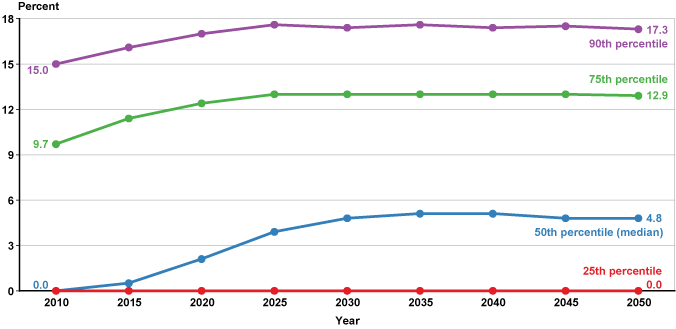
In addition to the median percentage of benefit income owed as income tax by beneficiary families, Chart iv shows the 90th-, 75th-, and 25th-percentile values. The chart covers all beneficiary families, including those that owe no income revenue enhancement on their Social Security benefits. Casher families at the 90th percentile of income tax liability on Social Security benefits paid 15.0 pct of their benefits as income tax in 2010; those families will owe 16.1 percent of their benefits as income tax in 2015 and about 17 percent in later years. Beneficiary families at the 75th percentile of income tax liability paid 9.seven pct of their benefits every bit income revenue enhancement in 2010. MINT projects that those families volition owe eleven.iv percent of their benefits as income tax in 2015 and well-nigh 13 percent over the period 2025–2050. The median percentage of benefit income due as income tax amongst all casher families is represented by the blue line, which duplicates the blue line in Chart 3, described earlier. Families at the 25th and lower percentiles of tax liability paid no income tax on their Social Security benefits in 2010, and MINT projects that they will not be required to pay income revenue enhancement on their Social Security benefits at any time in the flow 2015–2050.
Chart four.
Percentage of Social Security benefit income that is owed equally income tax amid beneficiary families: Selected percentiles, 2010 and projected quinquennially 2015–2050
SOURCE: Author's calculations using MINT7.
Benefit Income Owed as Income Tax by Total-Income Quartile
Because of the progressivity of income taxation rates, higher-income families owe higher percentages of their Social Security benefits as income taxation than do lower-income families. For case, a beneficiary family with income in the highest quartile pays a larger per centum of its benefits equally income tax than does a family in the everyman quartile. For each successive quartile, from everyman to highest, the projected percentages should increment.
To provide a consistent basis for comparing income over time, MINT projects the amounts that will ascertain the income-quartile boundaries among casher families from 2010 to 2050, and expresses them relative to the national AWI (Table 3). For example, among casher families in 2010, a family unit with total income equal to at to the lowest degree two.273 times the national AWI was in the quaternary (highest) income quartile. A beneficiary family was in the 3rd income quartile in 2010 if it had income between one.223 and 2.273 times the AWI. A beneficiary family with income between 0.624 and 1.223 times the AWI was in the 2d income quartile, and a beneficiary family with income of less than 0.624 times the AWI was in the first (lowest) income quartile.
| Twelvemonth | National AWI (nominal $) | Total family income relative to national AWI | ||
|---|---|---|---|---|
| 75th percentile | Median | 25th percentile | ||
| 2010 | 41,674 | ii.273 | 1.223 | 0.624 |
| 2015 | 50,893 | two.246 | 1.201 | 0.590 |
| 2020 | 63,676 | two.235 | 1.165 | 0.567 |
| 2025 | 76,831 | ii.229 | ane.162 | 0.572 |
| 2030 | 93,193 | ii.179 | 1.120 | 0.549 |
| 2035 | 113,228 | ii.133 | 1.089 | 0.537 |
| 2040 | 137,642 | ii.080 | 1.043 | 0.524 |
| 2045 | 167,076 | 2.005 | i.000 | 0.506 |
| 2050 | 202,452 | 1.942 | 0.959 | 0.490 |
| SOURCE: Writer's calculations using MINTvii. | ||||
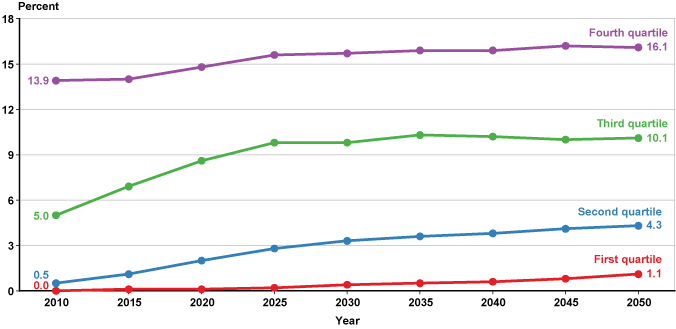
Chart 5 shows MINT projections of the hateful percentage of benefits paid as income tax by beneficiary families in each total-income quartile. Total income consists of pretax cash income from all sources, including the estimated corporeality a family would receive if it used its financial avails to purchase an annuity. Beneficiary families in the fourth income quartile paid xiii.9 percent of their benefits equally income revenue enhancement, on average, in 2010. MINT projects that families in the fourth income quartile volition owe xiv.0 percent of their benefits as income tax in 2015 and 14.8 per centum in 2020. From 2030 through 2050, MINT projects that families in the quaternary income quartile will owe about xvi percent of their benefits as income revenue enhancement.
Chart five.
Mean percentage of Social Security benefit income owed as income tax among beneficiary families, by total-income quartile: 2010 and projected quinquennially 2015–2050
SOURCE: Writer's calculations using MINT7.
On boilerplate, beneficiary families in the third income quartile paid 5.0 percent of their benefits equally income tax in 2010. MINT projects that those beneficiary families will owe 6.9 percent of benefits as income tax in 2015 and 8.6 per centum in 2020. Over the catamenia 2025–2050, MINT projects that beneficiary families in the third income quartile will owe an average of almost 10 percentage of their Social Security benefits in income taxes.
Beneficiary families in the lower half of the income distribution pay a substantially lower proportion of their benefits as income tax than practise those with income above the median. Families in the second income quartile paid less than 0.5 per centum of their benefits as income revenue enhancement in 2010 and they will owe 1.one percent of their benefits as income tax in 2015. That proportion volition rise to 3.iii per centum in 2030 and by 2050, MINT projects that families in the 2nd income quartile volition owe 4.3 per centum of their Social Security benefits in income tax. Families in the lowest quartile paid no income tax on their benefits in 2010. MINT projects that those families will owe just 1.1 percent of benefits every bit income tax past 2050.
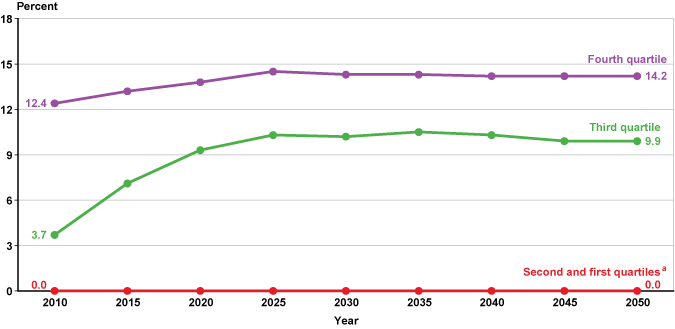
In contrast with Nautical chart 5'due south mean percentages, Chart 6 shows the median percentages of benefits paid as income tax by beneficiary families inside each income quartile. A family in the quaternary income quartile paid a median of 12.four percent of its benefits as income taxation in 2010 and is projected to owe 13.two percent in 2015 and about fourteen percent thereafter. A family unit in the tertiary income quartile paid a median of 3.7 percent of its benefits as income tax in 2010 and is projected to owe seven.1 percent in 2015 and between ix percentage and 11 percent from 2025 through 2050. MINT projects that the median tax liability for families in the second and starting time income quartiles will exist cipher throughout the flow 2010–2050.
Chart 6.
Median percentage of Social Security benefit income owed equally income tax amidst beneficiary families, by total-income quartile: 2010 and projected quinquennially 2015–2050
SOURCE: Writer's calculations using MINTseven.
a. Considering the projected median percentages for casher families in the second income quartile are zero in every twelvemonth, the projected median percentages for casher families in the first income quartile are necessarily also zero in all years.
Conclusion
Social Security benefits were first subject to income tax in 1984 and since and so, the proportion of beneficiary families whose benefits are taxed has increased from less than one in ten to more than than half. SSA'due south MINT microsimulation model, containing data on about 92 per centum of Social Security beneficiaries, projects that 52 percentage of casher families will pay income tax on their Social Security benefits in 2015. The median tax payment amidst all beneficiary families will equal less than 1 percent of do good income in 2015; but amongst merely those families whose benefits are taxable, the median income revenue enhancement payment will equal xi.1 per centum of Social Security benefits. By 2030, MINT projects that 58 percent of beneficiary families will owe income taxation on their Social Security benefits and that the median income taxation payment will equal about 5 per centum of their benefit income. Among families that owe income tax on their benefits, the model projects a median payment equal to 12 percent of benefit income in 2030. These estimates are based on the assumption that Congress volition ameliorate provisions of the Internal Acquirement Code that currently require tax-bracket adjustments based on price indexing; such amendments would assure that the proportion of income paid every bit income taxation would remain close to its current level. Otherwise, the percentage of Social Security benefits that will be owed as income tax will exceed the level that MINT has projected.
Because the progressivity of the federal income taxation assures that higher-income beneficiaries pay the most taxes, the revenue enhancement of benefits reduces the internet Social Security income received past higher-income beneficiaries. In that respect, taxing Social Security benefits has the aforementioned effect that a means test would accept, without the authoritative price that direct means testing would entail (Goodman and Liebman 2008).14 Means tests are effective for targeting benefits to persons who are most in need, but they can exist expensive to administer. In 2014, for instance, federal expenditures for the Supplemental Diet Assistance Program (SNAP) were $76 billion. Of that amount, iv.ix percent ($3.vii billion) went to authoritative expenses, including means testing. Based on full Social Security expenditures of $851 billion in fiscal year 2014, each percentage signal in hypothetical expenditures needed to institute means testing would raise annual Social Security program spending by more than than $8.5 billion.
Because Congress established income thresholds below which Social Security benefits are tax-exempt, benefit income continues to be taxed less heavily than income from annuities and pensions. Individuals with modified AGI of less than $25,000 and married couples with modified AGI of less than $32,000 pay no income taxation on their Social Security do good income. Because those income thresholds are not indexed to prices or wages, the proportion of beneficiaries who pay taxes on their benefits has increased over fourth dimension. Eventually, the revenue enhancement of Social Security benefits will be roughly equivalent to the current-law taxation of pensions and annuities—which, according to the legislative history of the 1983 amendments, was Congress' intent when information technology set the threshold for taxation of benefits in nominal dollars.
Notes
1 From 1950 through 2012, the ratio of income taxes to personal income averaged 9.5 percent per year. The annual ratio was never lower than seven.ii percent or greater than 11.6 percent (IRS 2014).
ii For well-nigh taxpayers, modified AGI equals AGI plus revenue enhancement-exempt interest income, income from foreign sources, and one-half of Social Security benefits.
3 Special rules apply to heads of households (unmarried parents) and married couples filing separately. Complete rules for counting Social Security and Tier 1 Railroad Retirement benefits as taxable income are included in IRS (2015a).
4 Pattison and Harrington (1993) describe the origins of both the income thresholds at which Social Security benefits become taxable and the percentage of benefits discipline to income tax.
5 Pattison (1994) describes the 1993 provisions that increased the tax of Social Security benefits.
6 Co-ordinate to IRS instructions, "if y'all paid part of the cost of your pension or annuity, yous are not taxed on the function of the pension or annuity you receive that represents a return of your price. The rest of the amount yous receive is generally taxable" (IRS 2015b, 77).
7 Every bit of 2015, a worker pays a Social Security payroll taxation of 6.2 percent on earnings up to $118,500. The worker's employer pays an equal corporeality, which is a tax-deductible business organisation expense. Self-employed workers are liable for the full 12.4 per centum payroll revenue enhancement, just they are eligible for ii taxation deductions: They may reduce their net earnings from self-employment by half the amount of the Social Security payroll tax, and they can deduct half of their Social Security taxation from personal income reported on IRS Form 1040. The payroll tax deduction is a factor in determining AGI (SSA 2015a).
8 The selection of nominal-dollar thresholds was deliberate, so that somewhen the tax treatment of Social Security income would be similar to that of pensions and annuities (Senate Finance Committee 1993).
ix Taxable income consists mainly of wages and salaries, interest, dividends, hire, royalties, uppercase gains, income from the sale of appurtenances or property, income from a farm or business organization, annuities, pensions, alimony, unemployment bounty, and distributions from retirement accounts other than qualified Roth distributions.
ten For the 2004 SIPP console, 88 percent of survey records were matched to their Social Security earnings records. The match rate for the 2008 panel was more than 90 per centum. Characteristics of nascency cohorts after 1979 are simulated rather than existence based on SIPP records.
11 MINT simulations for 2020 and later reflect samples that are successively more representative of the full population of aged beneficiaries, equally members of nascence cohorts from 1925 or earlier are replaced by members of afterwards cohorts over fourth dimension.
12 Results would exist similar if the assumed date of the switch to wage indexing were a few years earlier or afterward. For a clarification of the national AWI, meet https://www.socialsecurity.gov/oact/cola/AWI.html.
13 For 2015, MINT simulates the distribution of beneficiary units to be 21 percent filing singly, 50 percent married couples filing jointly, ane percent filing every bit the head of a household, and 28 percent not filing a revenue enhancement return.
14 Means tests limit eligibility for government-provided benefits or reduce the corporeality of the do good for individuals who have income or avails higher up thresholds set up in law. Temporary Aid for Needy Families (TANF), the Supplemental Nutrition Assistance Programme (SNAP), Supplemental Security Income (SSI), and Medical Assistance (Medicaid) are means-tested programs. Social Security and Medicare, as social insurance programs funded largely past payroll taxes levied on workers and their employers, are not means tested, although Medicare Part B (supplemental medical insurance) and Part D (prescription drug coverage) both accuse income-related premiums to participants.
References
1979 Informational Council on Social Security. 1979. Social Security Financing and Benefits: Report of the 1979 Advisory Council. Washington, DC: Department of Health, Education, and Welfare, SSA.
[Board of Trustees] Board of Trustees of the Federal One-time-Age and Survivors Insurance and Federal Disability Insurance Trust Funds. 2014. The 2014 Almanac Study of the Board of Trustees of the Federal Quondam-Age and Survivors Insurance and Federal Disability Insurance Trust Funds. Washington, DC: Government Printing Office. https://world wide web.socialsecurity.gov/oact/tr/2014/tr2014.pdf.
———. 2015. The 2015 Almanac Report of the Lath of Trustees of the Federal Sometime-Age and Survivors Insurance and Federal Disability Insurance Trust Funds. Washington, DC: Regime Press Part. https://www.socialsecurity.gov/oact/tr/2015/tr2015.pdf.
Goodman, Sarena, and Jeffrey Liebman. 2008. "The Taxation of Social Security Benefits as an Arroyo to Means Testing." NBER Retirement Research Center Newspaper No.NB08-02. Cambridge, MA: National Bureau of Economical Inquiry. http://www.nber.org/aging/rrc/papers/orrc08-02.pdf.
Goss, Stephen C. 1993. "Current Arroyo and Basis for Because a Change to 85-Percent Revenue enhancement of Monthly OASDI Benefits." Letter of the alphabet to Harry C. Ballantyne, Principal Actuary, Social Security Administration.
House Ways and Means Committee. Run across U.S. Congress, Firm Committee on Ways and Means.
[IRS] Internal Revenue Service. 2014. "SOI Tax Stats—Historical Tabular array 8." https://www.irs.gov/uac/SOI-Taxation-Stats-Historical-Table-8.
———. 2015a. Social Security and Equivalent Railroad Retirement Benefits. IRS Publication 915. http://www.irs.gov/pub/irs-pdf/p915.pdf.
———. 2015b. Your Federal Income Tax. IRS Publication 17. https://www.irs.gov/pub/irs-pdf/p17.pdf.
National Commission on Social Security Reform. 1983. Report of the National Commission on Social Security Reform. https://world wide web.socialsecurity.gov/history/reports/gspan.html.
Pattison, David. 1994. "Tax of Social Security Benefits Under the New Income Tax Provisions: Distributional Estimates for 1994." Social Security Bulletin 57(2): 44–50. https://www.socialsecurity.gov/policy/docs/ssb/v57n2/v57n2p44.pdf.
Pattison, David, and David Eastward. Harrington. 1993. "Proposals to Modify the Taxation of Social Security Benefits: Options and Distributional Furnishings." Social Security Bulletin 56(two): iii–21. https://world wide web.socialsecurity.gov/policy/docs/ssb/v56n2/v56n2p3.pdf.
Senate Finance Committee. See U.S. Congress, Senate Committee on Finance.
Shakin, Joshua, and Kurt Seibert. 2015. "The Taxation of Social Security Benefits." Washington, DC: Congressional Budget Function. https://www.cbo.gov/publication/49948.
Smith, Karen Eastward., and Melissa Yard. Favreault. 2013. "A Primer on Modeling Income in the Most Term, Version 7 (MINTvii)." Washington, DC: Urban Institute. http://www.urban.org/sites/default/files/alfresco/publication-pdfs/413131%twenty-%20A-Primer-on-Modeling-Income-in-the-Near-Term-Version-MINT-.pdf.
[SSA] Social Security Assistants. 2015a. "If You Are Self-Employed." SSA Publication No.05-10022. https://www.socialsecurity.gov/pubs/EN-05-10022.pdf.
———. 2015b. "Monthly Statistical Snapshot." https://world wide web.socialsecurity.gov/policy/docs/quickfacts/stat_snapshot/.
———. n.d. "Social Security History: Treasury Rulings on Revenue enhancement of Benefits." https://www.socialsecurity.gov/history/it3447.html.
U.S. Congress, Firm Committee on Ways and Means. 2004. Groundwork Cloth and Information on the Programs within the Jurisdiction of the Commission on Means and Means. Commission Print No.108-6. Washington, DC: Regime Press Role.
U.Southward. Congress, Senate Committee on Finance. 1993. Taxation of Social Security Benefits. Senate Hearing No.103-316. Washington, DC: Government Printing Office.
Source: https://www.ssa.gov/policy/docs/issuepapers/ip2015-02.html

Post a Comment for "Why Are We Taxed Again for Social Security"